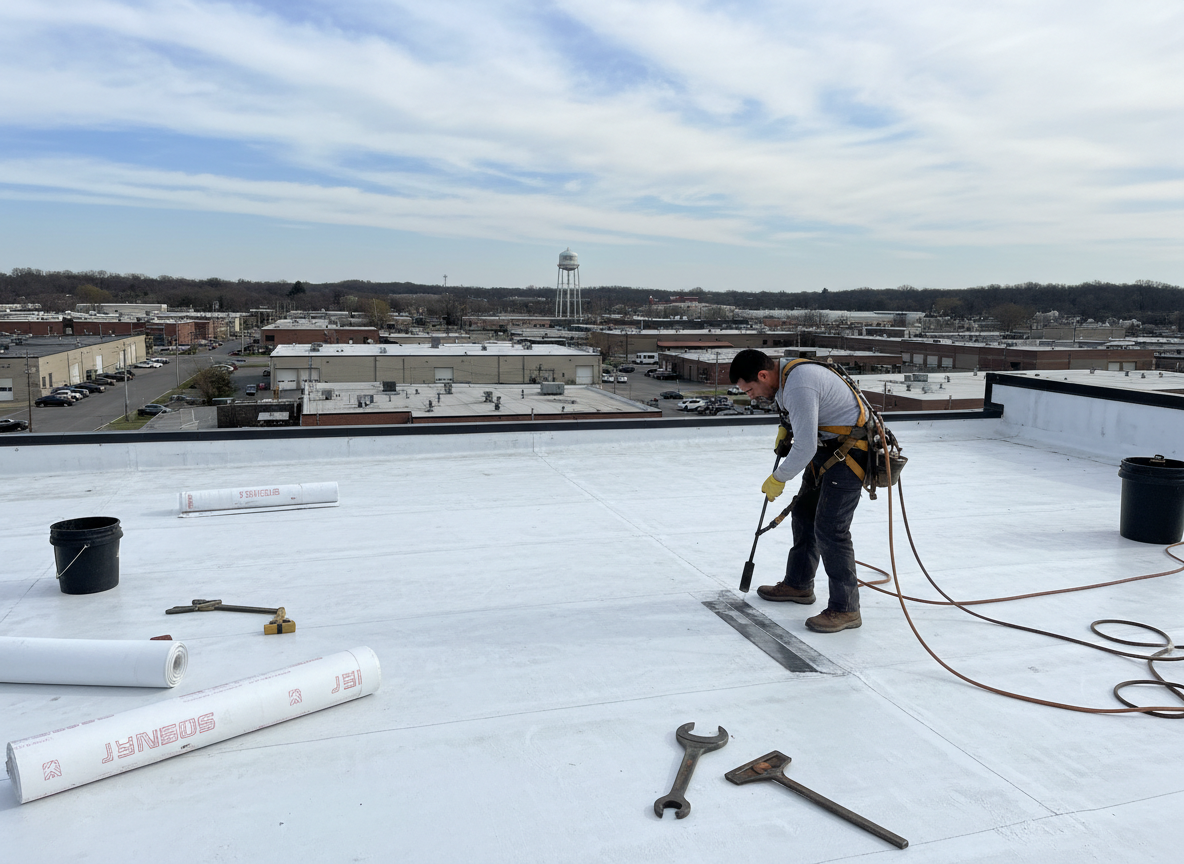
Commercial buildings in Union and Ryle often feature low-slope or flat roofs that must handle the region's humid subtropical climate. High summer moisture levels combined with occasional winter freezes can lead to condensation under the membrane if ventilation and insulation details are not addressed during installation. TechPatch evaluates drainage patterns around structures near Union Community Park and along Cavalry Lane before recommending single-ply or modified systems that resist ponding.
Boone County commercial properties frequently sit on gently rolling terrain that directs runoff toward foundations when roof edges lack proper flashing. Older retail and office buildings between Union and Florence commonly show seam failures after years of UV exposure and tree debris accumulation. Proper edge metal and cricket installations prevent water from migrating under the roof deck during the heavy spring rains typical here.
Work on commercial roofs in this area requires coordination with local access restrictions and storm-water rules that affect material staging near busy corridors connecting Union to Burlington. TechPatch schedules tear-offs and installs around business hours to limit disruption while ensuring new membranes meet wind-uplift expectations for the mild but occasionally gusty winter fronts that move through northern Kentucky.
Technician insight
In Union, the thing that catches most people out with Commercial Roofing is how the mild winters let humidity linger under older flat roofs around Union Community Park, so a small seam leak turns into widespread deck rot before anyone notices during a quick drive-by inspection.
Retail Center Roof Upgrade
A strip center near Ryle showed repeated interior leaks after spring storms. Inspection revealed failed seams on the existing EPDM and blocked scuppers. We replaced the membrane with heat-welded TPO, added tapered insulation for positive drainage, and cleared all outlets. The building has stayed dry through subsequent heavy rains.
How it works
- 1
Site Assessment
Measure roof dimensions, check drainage, and note existing membrane condition on the commercial structure.
- 2
Material Selection
Recommend TPO, EPDM, or modified bitumen based on building use, slope, and exposure to Boone County weather.
- 3
Preparation and Removal
Remove old roofing, repair decking, and install new insulation or cover board as needed.
- 4
Installation
Apply new membrane with heat-welded or adhered seams, flash all penetrations, and secure edges.
- 5
Final Inspection
Walk the completed roof, test drainage, and provide maintenance recommendations.
Pricing
Pricing varies by roof size, chosen membrane, and access needs; we provide detailed upfront quotes after an on-site visit.