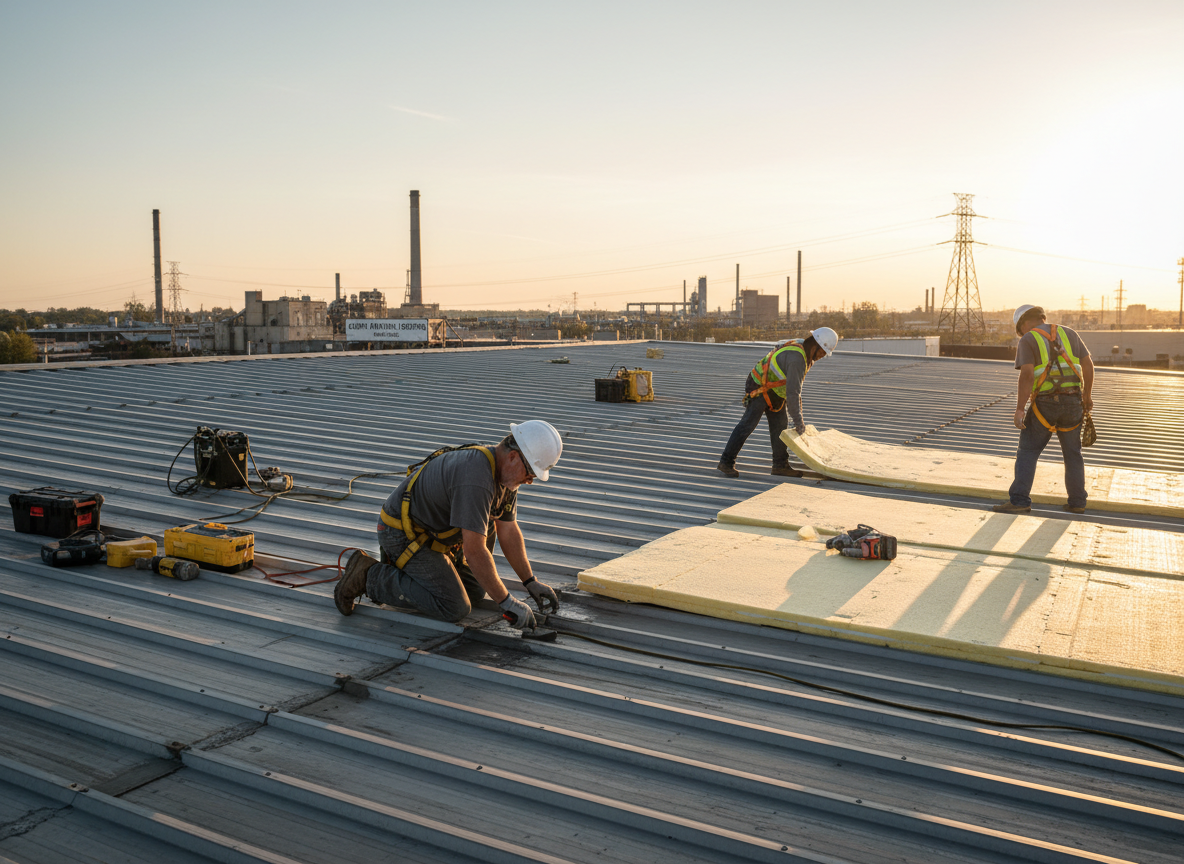
Industrial roofs in Union and nearby Ryle often cover warehouses and manufacturing buildings with wide spans that demand reinforced decking and precise seam sealing. Boone County's humid subtropical climate brings frequent moisture that can accelerate corrosion on metal panels if underlayment and ventilation are not matched to the building's original construction. Crews working near Union Community Park must also account for wind patterns that funnel through open terrain and increase uplift risk on older industrial structures.
Flashings around HVAC units and skylights require extra attention because mild winters still allow condensation cycles that trap water under insulation. Local codes in Boone County call for specific wind-load ratings on larger buildings, and crews must verify attachment patterns against the actual roof deck condition rather than relying on generic manufacturer specs. Access challenges appear quickly on sites near Florence where truck courts limit staging space and require careful material handling to avoid disrupting operations.
Edge cases include retrofitting single-ply membranes over existing built-up roofs on buildings that predate current drainage standards. Proper slope correction prevents ponding that becomes common after years of minor settlement in the county's clay-heavy soils. TechPatch works from the Cavalry Ln address with round-the-clock availability to address leaks that surface during sudden downpours common even in milder seasons.
Technician insight
In Union, the thing that catches most people out with industrial roofing contractors is how the mild winters still let condensation build under insulation on older metal decks near Ryle, especially when crews skip proper vapor retarders during a re-cover.
Ponding Water on Warehouse Roof in Union
Problem: Standing water developed on a low-slope industrial roof after years of minor deck settlement. What we found: Original drains had been partially blocked by debris and the insulation had compressed in several bays. What we did: Added tapered insulation crickets, replaced clogged drains, and installed a reinforced single-ply membrane with upgraded perimeter securement. Outcome: The roof now sheds water cleanly and the facility reported no further interior moisture issues after the first heavy rain.
How it works
- 1
Site Assessment
Walk the roof and inspect deck, drains, and penetrations to identify active leaks and structural concerns specific to the building's age and location in Boone County.
- 2
Material Selection
Match membrane or metal systems to the roof's span, existing slope, and exposure to Union-area humidity and wind loads.
- 3
Preparation and Repair
Remove damaged sections, reinforce weak deck areas, and install new flashings around curbs and edges before the main roof installation.
- 4
Installation and Testing
Apply the chosen system with manufacturer-required seam welding or fastening patterns, then perform water testing on all drains and transitions.
- 5
Final Walk and Documentation
Review completed work with the facility contact and provide maintenance guidance tailored to local weather patterns.
Pricing
Project pricing depends on roof size, existing condition, material choice, and access constraints; TechPatch provides upfront quotes after the site visit.