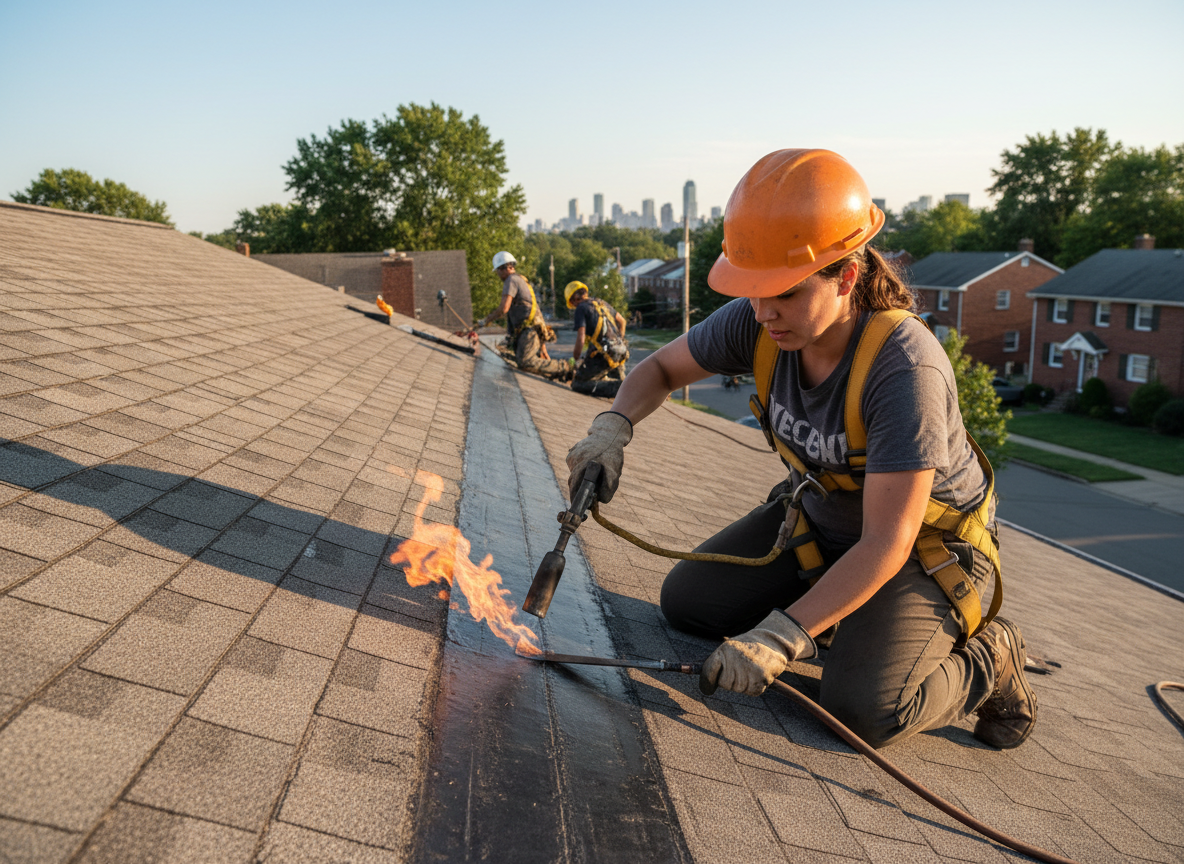
Union sits in Boone County with a mix of 1990s to early 2000s single-family homes and newer builds along Cavalry Lane. These roofs often face high humidity that drives algae growth on asphalt shingles and occasional ice damming during the rare hard freeze. Roofing specialists here focus on ventilation checks and ridge vent upgrades because standard ridge boards trap moisture when summer dew points stay above 70 degrees for weeks.
Work near Union Community Park and Ryle requires attention to tree canopy overhangs that drop leaves and pine needles into valleys. This debris accelerates granule loss on south-facing slopes. Crews routinely remove and replace underlayment in those sections rather than patching because the mild winters allow constant moisture cycling that breaks down felt faster than in drier climates.
Florence and Burlington crews see the same wind-driven rain patterns that push water under step flashing on chimneys and skylights. A roofing specialist inspects counter-flashing depth and sealant condition at every seam because once water reaches the decking it travels along the roof plane before showing inside the attic.
Local code in Boone County now requires ice-and-water shield at eaves extending six feet up the roof plane on all re-roofs. Specialists verify this during tear-off because many existing homes still have only single-layer felt that fails under the area's humidity load.
Technician insight
In Union the thing that catches most people out with roofing specialist work is the constant humidity pushing moisture under old step flashing on chimneys. Homes built in the Ryle area from the late 90s often have single-layer felt that looks fine from the street but has already started to rot at the valleys. We always pull back a section during inspection because once you see the decking stain you know the whole valley needs new underlayment before the next heavy rain.
Valley Leak Near Union Community Park
Homeowner noticed water stains along a second-floor ceiling after several humid weeks. Inspection found pine needles blocking the valley and degraded felt underneath. We removed the old underlayment, installed new ice-and-water shield, and replaced the shingles with matching architectural style. No further leaks reported through the following winter.
How it works
- 1
Site Inspection
Walk the roof and attic to map leaks, ventilation, and existing layers while noting exposure to Union humidity and tree cover.
- 2
Material Assessment
Check shingle condition, underlayment integrity, and flashing details against Boone County requirements for ice-and-water shield.
- 3
Scope and Quote
Provide written scope covering tear-off, ventilation upgrades, and any valley or chimney work specific to the home's age and orientation.
- 4
Execution
Remove old layers, install new underlayment and ice shield where required, then apply shingles with proper nailing patterns for local wind exposure.
- 5
Final Walk
Inspect all seams, vents, and gutters from the ground and attic to confirm no debris remains and drainage functions correctly.
Pricing
Upfront quotes after on-site inspection; cost varies with roof pitch, number of layers, and ventilation needs.